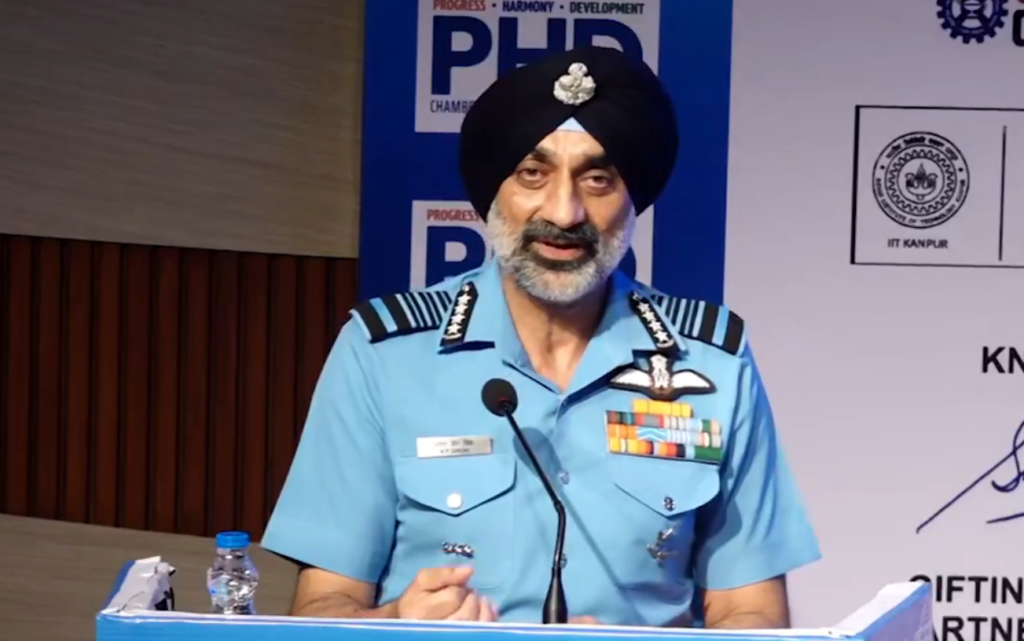
The Indian Air Force (IAF) Chief, Air Chief Marshal Amar Preet Singh, has urged a significant transformation in India’s drone ecosystem during the Bharat Drone & Robotics Manthan 3.0 conference held recently in New Delhi. He highlighted the urgent need for self-reliance in drone development to enhance the country’s defence capabilities.
Addressing the audience, Air Chief Marshal Singh paved a way forward for the IAF to foster closer partnerships with local industries and innovators. He observed that modern warfare increasingly hinges on the efficiency and effectiveness of unmanned systems, making it imperative for India’s defence sector to adapt swiftly to evolving technological landscapes.
“The problem statement has to originate from us. We have the Directorate of Aerospace Design (DAD) to engage with startups and innovators so they understand our requirements,” Singh emphasised as he outlined a vision for enhanced collaboration.
In a progressive initiative, the IAF announced the Dronathon 2026 competition scheduled for September. This event will invite companies to demonstrate their drone technologies live, significantly streamlining traditional evaluation processes that often rely on extensive paperwork and video presentations.
Singh articulated the vulnerabilities associated with foreign supply chains while emphasising a crucial point: “Every brick should be developed in India. Then only can we claim to be fully Atmanirbhar,” which translates to being self-reliant.
He pointed out that delays in adopting new technologies could hamstring military readiness, stating, “Technology delayed is technology denied.” His call to action urged a cohesive national effort incorporating academia, regulatory bodies, investors, and manufacturers to facilitate the transition of innovative ideas from design to deployment.
Moreover, Singh reinforced that while drones are pivotal, they are meant to complement manned aerospace platforms rather than replace them entirely. The proactive approach of the IAF signifies a shift towards viewing operational challenges as opportunities for collaboration, particularly for India’s growing aerospace startups.
“If we keep doing what we are doing, we will get the same results. If we want different results, we must pursue innovative strategies,” Singh remarked, underlining a pivotal position for local innovation in the nation’s defence strategy.
The Bharat Drone & Robotics Manthan 3.0 not only underscores the importance of innovation in military applications but also proves to be a significant platform for startups to engage in meaningful dialogue with defence authorities. This engagement can reshape the trajectory of defense technologies in India.
In conclusion, the IAF’s commitment to developing a robust indigenous drone ecosystem aligns with national priorities of self-reliance in defence capabilities. The focus on collaboration among various sectors forecast a promising outlook for India’s future in aerial technology and self-sufficiency.