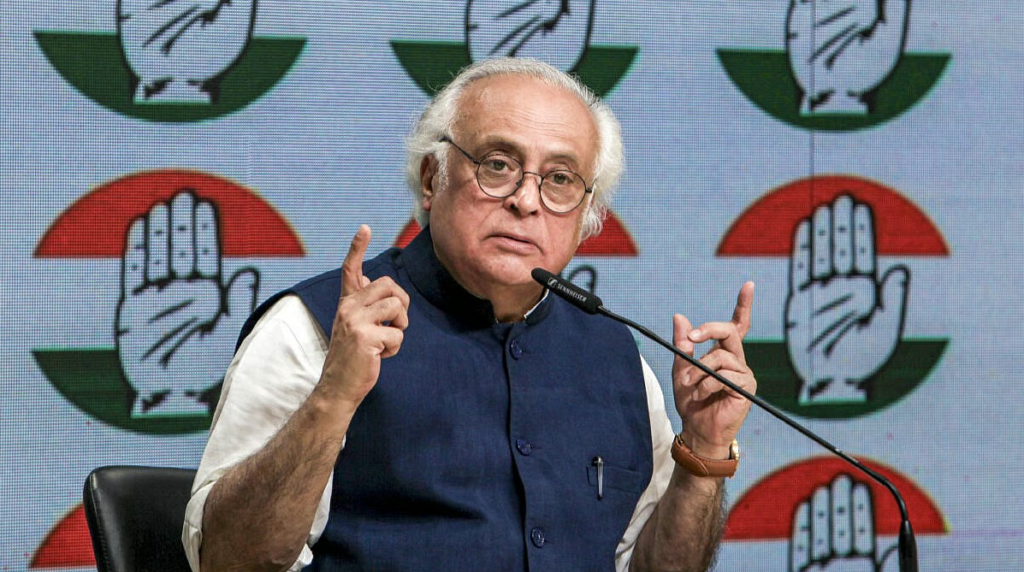
The Congress party delivered a resolute message on Thursday, asserting its firm resistance to any attempts to broaden the scope of post-facto environmental clearances. This stance comes in light of a recent Supreme Court ruling that reinforces the principles of environmental law.
On Wednesday, the Supreme Court quashed a 2021 office memorandum allowing retrospective environmental clearances to projects that began without prior approval. The court emphasized that such protective environmental checks must not be altered through administrative orders.
Jairam Ramesh, Congress leader and former Environment Minister, recognized the significance of this ruling. He referred to a landmark judgment from May 2025 that confirmed the necessity of prior environmental clearance. The judgment scrutinized the post-facto approval mechanisms introduced by the 2017 Notification and the 2021 Office Memorandum.
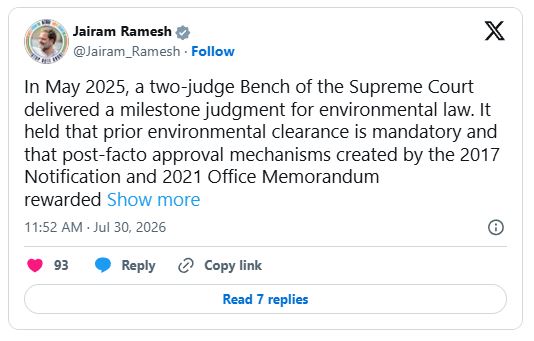
Ramesh stated, “These mechanisms rewarded illegality and undermined the Environmental Impact Assessment (EIA) process, which is crucial for sustainable development and the right to a clean environment.” He criticized the Union Government’s review request, which claimed the judgment jeopardized projects worth millions that had proceeded without necessary clearances.
Justice Ujjal Bhuyan’s dissenting opinion highlighted that there is “no concept of ex-post facto environmental clearance in environmental law.” Ramesh pointed out this critical perspective as a reminder of the stringent rules governing environmental protection.
The Supreme Court’s latest judgment signifies a positive shift, according to Ramesh. Nevertheless, the ruling permits the government to establish a statutory mechanism for post-facto environmental clearances under ‘exceptional circumstances,’ leaving the definition of these circumstances open to government interpretation.
Ramesh outlined various projects facing scrutiny, including those in Great Nicobar and the Ken-Betwa project, along with mining operations in Odisha and extractive activities in Chhattisgarh. He emphasized a recurring theme of governmental and corporate disregard for environmental regulations, treating them as obstacles rather than fundamental responsibilities.
“For 17 years, I have supported numerous public campaigns against the dilution of India’s hard-earned environmental protections,” Ramesh stated. He reaffirmed Congress’s intention to continue striving to protect essential environmental laws and safeguard marginalized communities.
A bench composed of Chief Justice Surya Kant and Justices Joymalya Bagchi and Vipul M Pancholi issued a unanimous verdict, allowing the judgment’s prospective application. This decision protects projects that had already received retrospective environmental clearances from possible punitive actions.
The Supreme Court recognized the central government’s authority under Section 3 of the Environment (Protection) Act, 1986, to issue necessary notifications that may consider amnesty schemes for specific non-compliant projects that align with public interest.
Examples of such projects include healthcare facilities like the AIIMS Medical College and Hospital in Odisha, and infrastructure projects aimed at benefiting communities in drought-prone areas and slum rehabilitation.
“We invalidate the 2021 Office Memorandum and quash it with prospective effect,” stated the bench. “This is based on substantial public interest and the need to resolve ongoing legal uncertainties surrounding the precedent.”
The court emphasized balancing the ecological rights of all living beings with sustainable development aspirations. In doing so, it adhered to the Gandhian principle that ensures resources are used judiciously
The bench affirmed its responsibility to navigate the tension between development needs and environmental protection within an anthropocentric world. By reaffirming its commitment to eco-centric proportionality, the court aims to ensure sustainable governance practices.