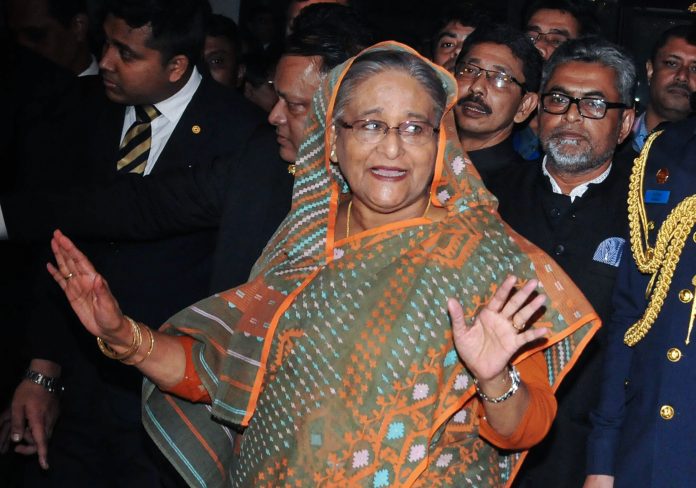
Former Prime Minister Sheikh Hasina has declared her return to Bangladesh depends on the restoration of “participatory democracy”, lifting the ban on the Awami League, and conducting free, fair, and inclusive elections. Speaking in an exclusive email interview with PTI from India, Hasina criticized the Yunus-led interim administration for damaging relations with India and enabling extremist forces.
Hasina expressed deep gratitude for the refuge provided by the Indian government. “I am immensely grateful to India’s government and its people for their kind hospitality,” she stated, underlining India’s significance to Bangladesh.
“The most crucial condition for my return to Bangladesh is the same condition that the Bangladeshi people require: a return to participatory democracy,” she remarked emphatically. Hasina stressed that the interim government must revoke the ban on her party, the Awami League, ensuring that future elections are inclusive.
Bangladesh’s longest-serving leader, Hasina, left her country on August 5, 2024, amidst escalating anti-government protests that led to her resignation. When questioned about the protests, the 78-year-old acknowledged the government lost control. “Obviously, we lost control of the situation, and that was regrettable,” she clarified, while attributing blame to “seasoned political firebrands masquerading as student leaders” for igniting the chaos.
Hasina refuted allegations that she called for a boycott of the upcoming elections scheduled for February next year, asserting that any election excluding the Awami League would lack legitimacy. “Tens of millions of people support us… It would be a huge missed opportunity for a country that badly needs a government with genuine consent of the people,” she insisted.
In a biting critique of Dr. Muhammad Yunus, the interim leader, Hasina accused him of fostering an anti-India stance, underlining the danger it poses to Bangladesh’s most strategic partnerships. “Yunus’ hostility to India is foolish and self-defeating… He is unelected, chaotic, and dependent on extremist forces,” she said, warning that Yunus’ diplomatic blunders may severely damage bilateral relations.
Reassuring Indian citizens concerned by recent developments in Bangladesh, Hasina stated, “The interim government doesn’t represent what our people think. India is and will remain our nation’s most important friend.” Her remarks aimed to dispel fears regarding the future of India-Bangladesh ties.
Taking a bold stance, Hasina announced her willingness to stand trial under international supervision, even at the International Criminal Court (ICC). She accused Yunus of deliberately avoiding such scrutiny, claiming, “An impartial tribunal would acquit me.” Furthermore, she described the Bangladesh International Crimes Tribunal, which seeks the death penalty against her, as a “kangaroo tribunal” aiming to politically marginalize her and demolish the Awami League.
“They want to eliminate us as political forces. The fact that they would use the death penalty to silence opponents shows how little respect they have for democracy or due process,” Hasina lamented.
Hasina further commented on Yunus’ initial support from Western liberals, suggesting it has diminished as they witness his government placing radicals in key positions, discriminating against minorities, and dismantling constitutional principles.