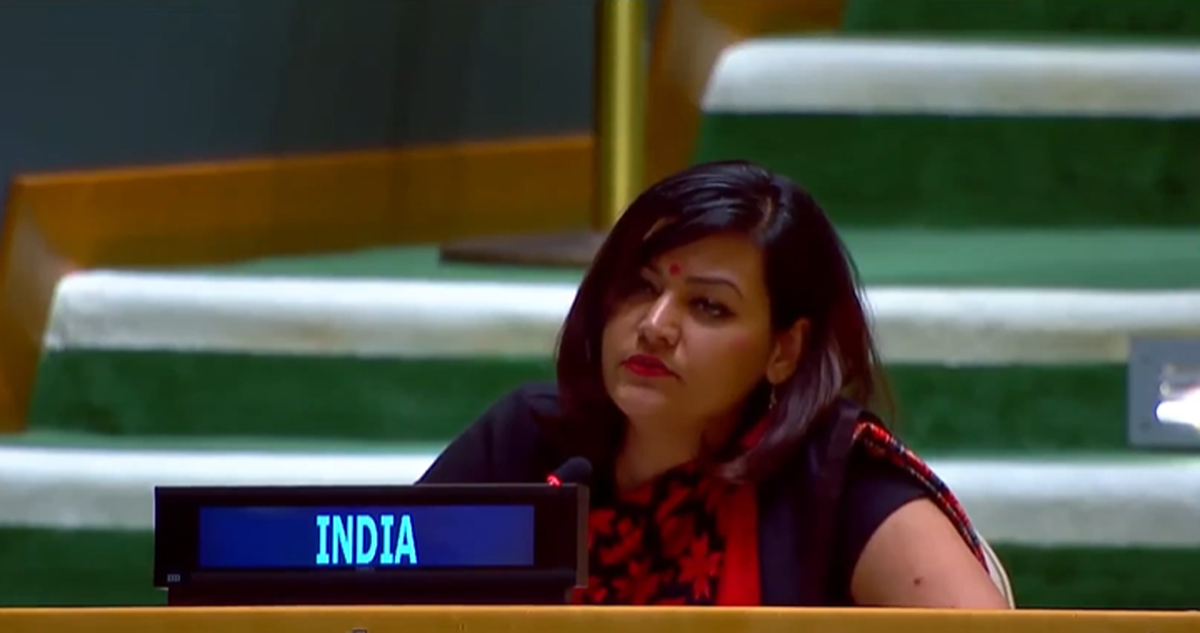
On September 27, India announced that during Operation Sindoor, Pakistan’s military “pleaded” for a cessation of hostilities. This revelation came amid rising tensions and was made by Petal Gahlot, First Secretary at India’s Permanent Mission to the United Nations. Gahlot emphasized that no third-party intervention is necessary regarding issues between New Delhi and Islamabad.
These comments followed a statement from Pakistan Prime Minister Shehbaz Sharif during the General Debate of the 80th session of the UN General Assembly (UNGA). Sharif had credited former U.S. President Donald Trump, claiming his involvement once prevented a war between the two nuclear-armed nations.
“This Assembly witnessed absurd theatrics in the morning from the prime minister of Pakistan, who once again glorified terrorism that is so central to their foreign policy,” Gahlot stated as he delivered India’s Right of Reply at the UNGA.
Sharif asserted that Pakistan is open to a “composite, comprehensive and result-oriented” dialogue with India, focusing on all outstanding issues, particularly the Kashmir situation. He praised Trump’s peace efforts, stating they helped avoid potential conflict in South Asia.
“In recognition of President Trump’s wonderful and outstanding contribution to promote peace in our part of the world, Pakistan nominated him for the Nobel Peace Prize. This is the least we could do… I think he truly is a man of peace,” Sharif remarked.
In retaliation for the deadly Pahalgam terror attack on April 22 that resulted in 26 civilian deaths, India initiated Operation Sindoor on May 7. This operation targeted terror infrastructure located in Pakistan and Pakistan-occupied Kashmir.
India maintains that the cessation of hostilities understanding was achieved through direct talks between the Directors General of Military Operations from both nations. The ongoing interactions raise questions about the feasibility of dialogue as both nations navigate complex geopolitical landscapes.
The situation continues to draw international attention, as political analysts evaluate the effectiveness of diplomatic communications between India and Pakistan. Observers suggest that the recent exchanges at the UN embody the layered complexities that have historically characterized Indo-Pak relations.