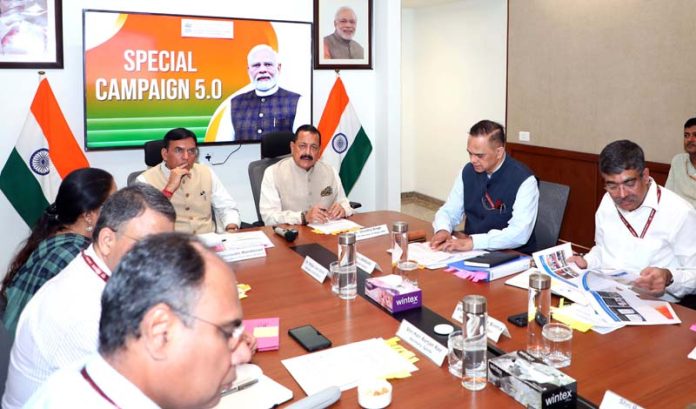
Union Minister of State (Independent Charge) for Science & Technology, Dr. Jitendra Singh, called for ministries to transform the Government’s ongoing cleanliness initiative into a mass movement that promotes public participation, innovation, and private sector engagement. This appeal came during a high-level review meeting on the Special Campaign 5.0 held recently.
During the meeting, Dr. Singh pointed out the necessity of moving beyond symbolic efforts to make cleanliness, space optimization, and record management integral to day-to-day governance. He asserted, “We should integrate technology, community engagement, and private sector collaboration to ensure that the campaign sustains itself throughout the year.”
The Minister proposed leveraging corporate partnerships and MSME collaborations through NASSCOM for effective waste management solutions, particularly in urban clusters, hotels, and government establishments. He highlighted the integration of digital technologies and smart recycling models, such as automated waste segregation and electronic scrap management. Such initiatives could enhance operational efficiency while creating new livelihood opportunities.
Dr. Jitendra Singh stressed the importance of sharing best practices across various ministries. He suggested documenting successful cleanliness models – from public spaces to educational campuses – so they can be disseminated nationally through a central repository. Moreover, he urged the identification of innovative initiatives like electronic file disposal, smart waste reuse, and the repurposing of cleared government land to set new benchmarks in governance.
The Minister recognized that the involvement of youth and women could inject new energy and creativity into the campaign. “When young people and women join the movement, it becomes more vibrant and impactful,” he remarked. He urged that messages related to Cleanliness should be amplified through schools, colleges, and My Bharat volunteers in order to instill a culture of collective responsibility.
Reflecting on the success of earlier campaigns, Dr. Jitendra Singh emphasized how the Special Campaign has evolved from a mere short-term cleanliness drive into a transformative governance model. This model promotes efficiency, transparency, and citizen-centric administration. He reiterated the Government’s commitment to sustain this momentum, under Prime Minister Narendra Modi’s leadership, stating that innovative best practices from the campaign would be shared with States, PSUs, and autonomous bodies.
In his address, Union Minister of Health and Family Welfare, Dr. Mansukh Mandaviya, highlighted the crucial role of behavioural change and youth participation in achieving the vision of “Swachh Bharat.” He emphasized the appointment of student and youth ambassadors from colleges and universities to drive awareness and motivate people to maintain cleanliness in their communities.
This high-level meeting included participation from V. Srinivas, Secretary of DARPG, Sarita Chuhan, Joint Secretary of DARPG, and various senior officials from the Department of Administrative Reforms and Public Grievances (DARPG) and other partner organizations. Their collective insights aim to refine and amplify the ongoing cleanliness and governance initiatives across the country.