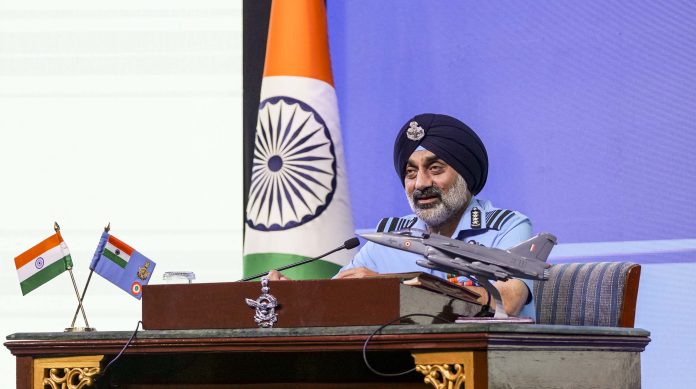
On Friday, Indian Air Force (IAF) Chief Air Chief Marshal Amar Preet Singh disclosed key details of Operation Sindoor, where 4 to 5 Pakistani F-16s were destroyed on the ground. This operation represents a significant strategic achievement for India.
During a media briefing in New Delhi, Singh revealed that the IAF executed precision strikes on multiple Pakistani airbases. The operation aimed at crippling Pakistani military capabilities, damaging crucial infrastructure such as radars, command centres, runways, and hangars. He noted that a C-130-class transport aircraft and possibly a high-value surveillance plane were also among the targets hit.
“We struck a large number of their airfields and installations…radars at four places, command centres at two locations, two runways, and three hangars were destroyed. We have evidence of one C-130 aircraft being hit, and at least 4–5 fighters, most likely F-16s, which were under maintenance at that time,” Singh asserted.
Singh further elaborated that the IAF deployed its newly procured long-range Surface-to-Air Missiles (SAMs) during the operation. These advanced systems successfully constrained the Pakistan Air Force’s ability to operate even within its own airspace, showcasing India’s growing military capabilities.
The operation achieved a significant milestone with the longest successful missile strike of over 300 kilometres. This strategic advantage severely impaired Pakistan’s aerial response capabilities and demonstrated India’s precision and reach.
Describing the operation as a decisive and time-bound success, Singh remarked, “This was a war started with a clear objective and concluded swiftly once our goals were achieved. Unlike prolonged global conflicts, India demonstrated that clarity and precision can force an adversary to ask for a ceasefire.”
He also highlighted the importance of this operation as a lesson for the world. In a landscape where ongoing international conflicts appear to be protracted, Singh emphasized that rapid and decisive action can lead to swift resolutions.
The details shared by Singh come amidst rising tensions in the region, underscoring the need for strategic military preparedness. With Operation Sindoor, the IAF has signalled its readiness and capability to address any threats on the subcontinent.
Military analysts note that these developments could shift the balance of air power in South Asia, prompting discussions among defence experts regarding future engagements between the two nations. The implications of this operation extend beyond mere destruction, pointing towards an evolving military strategy from the Indian side.
As tensions evolve, the international community will be closely watching India’s military maneuvers and their potential impacts on regional stability.