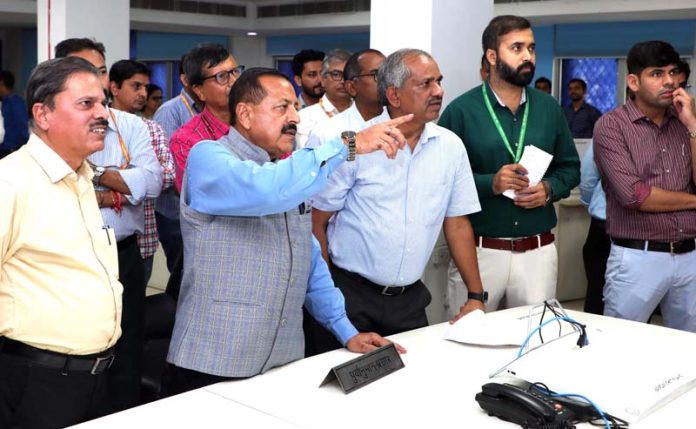
Union Minister of State (Independent Charge) for Science and Technology, Dr. Jitendra Singh, visited the India Meteorological Department (IMD) on March 29, 2023, to review the indigenous Multi-Hazard Early Warning Decision Support System (DSS). This innovative system has reportedly saved ₹250 crores, contributing to a self-reliant India.
Dr. Singh commended the IMD’s efforts in creating a technology-driven and citizen-centric forecasting platform that strengthens disaster preparedness and public safety. The DSS not only reduces dependency on foreign technologies but also results in an annual cost saving of ₹5.5 crores in maintenance, echoing the government’s Atmanirbhar Bharat initiative.
During his review, he also examined “Mausamgram”, a citizen-focused platform providing hyperlocal weather forecasts at the village level. This system delivers hourly forecasts for up to 36 hours, three-hourly forecasts for five days, and six-hourly forecasts for ten days. Users can easily access weather updates using their PIN code or by selecting their state, district, block, and gram panchayat. The platform’s availability in all official Indian languages promotes inclusivity and accessibility.
The IMD has taken significant steps to modernize its forecasting and alert generation mechanisms. They increased the lead time from five to seven days, reduced the preparation time by three hours, and enhanced forecast accuracy by 15-20%.
In discussions with IMD officials, Dr. Singh advocated for the inclusion of AI-based tools in the Mausamgram platform to improve its interactivity and user-friendliness. He also insisted on strengthening the Multi-Hazard Early Warning System to ensure that citizens receive clear and actionable alerts, crucial for timely responses during emergencies.
The Minister acknowledged IMD’s recognition at the National Award for e-Governance 2025, awarded at the 28th National Conference on e-Governance in Visakhapatnam, underscoring the agency’s excellence in digital public service delivery through the DSS.
Moreover, Dr. Singh highlighted the accomplishments of the IMD under the Special Swachhata Program, which successfully generated ₹30 lakh from the disposal of e-waste and old files, clearing up 600 square meters of space. He participated in the “Special Swachhata Program 5.0” at the IMD headquarters, where he planted a sapling as part of the “Ek Ped Maa Ke Naam” initiative and honored 50 “Safai Mitras” for their dedication.
Looking ahead, Dr. Singh shared the vision for Mission Mausam, which aims to install advanced meteorological instruments by 2030 to improve IMD’s forecasting capabilities. This plan includes 5×5 km-scale hazard forecasting, dynamic impact-based forecasting, and risk-based early warnings. The ultimate goal is to achieve last-mile connectivity to ensure timely alerts reach every household, thus fulfilling the mantra of “Har Har Mausam, Har Ghar Mausam.”